


DDR, DDR2, DDR3, DDR4, DDR5, DDR6: Features, Applications
DDR Memory Explained: DDR1 to DDR6 Differences and Features
DDR RAM plays a critical role in modern computing systems, enabling high-speed data processing and efficient multitasking.
DDR6 is an upcoming generation, and engineers are still finalizing its performance and specifications.
DDR Memory Generations Comparison
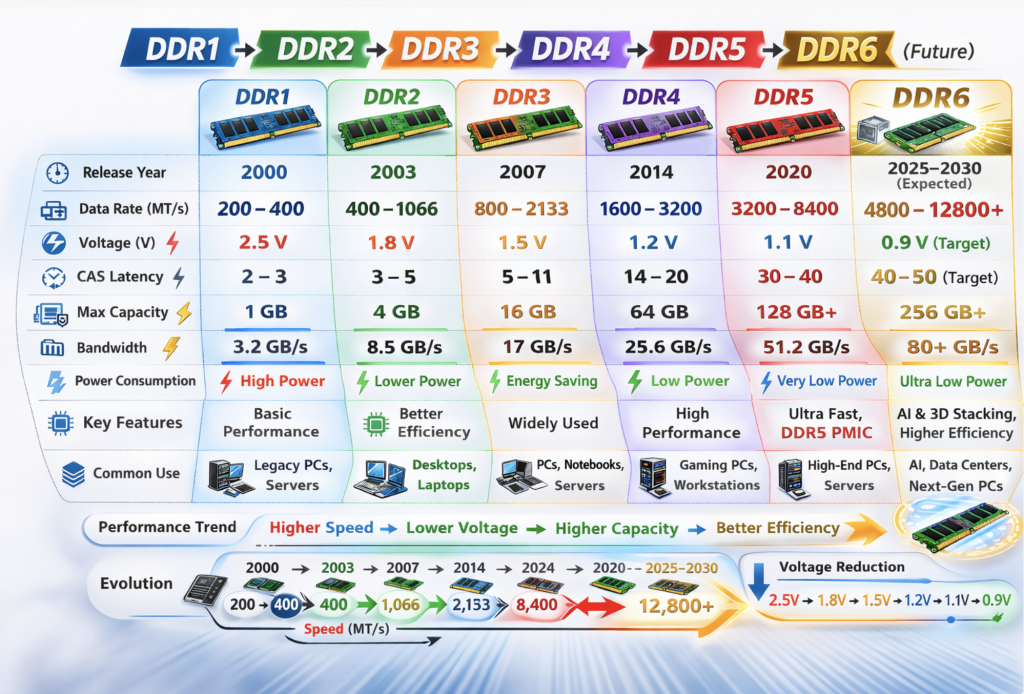
This diagram highlights the key differences between DDR1 through DDR6 memory technologies. Each generation represents a major step forward in speed, bandwidth, and power efficiency. As a result, users can easily compare how memory performance has evolved over time.
From DDR1, the first Double Data Rate memory, to DDR5 and the upcoming DDR6, every generation introduces improvements that support increasingly demanding computing tasks. Overall, the chart provides a clear and concise way to understand these advancements at a glance.
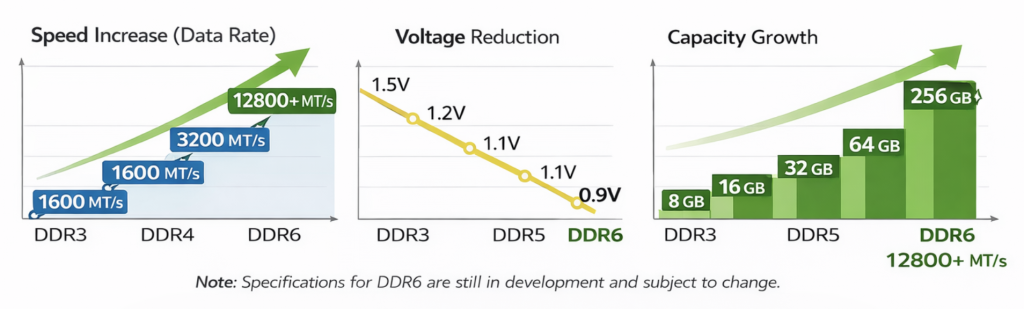
Why DDR Memory Continues to Evolve?
As computing power continued to grow, traditional SDRAM gradually became insufficient for modern workloads. For example, applications such as gaming, multimedia processing, cloud computing, and servers required faster data access and higher efficiency.
To solve these limitations, engineers introduced DDR Meomory. Unlike SDRAM, DDR transfers data on both the rising and falling edges of the clock signal. Consequently, this effectively doubles the data rate without increasing the clock frequency.
Over time, each DDR generation evolved to overcome the bottlenecks of its predecessor:
- The first generation introduced the core double data rate concept
- The second generation improved speed and reduced power consumption
- The third generation enhanced stability and increased capacity
- The fourth generation optimized density and reliability
- The fifth generation significantly boosted bandwidth and introduced advanced power management
- Meanwhile, the sixth generation continues to target extreme-performance computing
In short, DDR Memory has continuously evolved to meet the growing demands of modern computing systems.
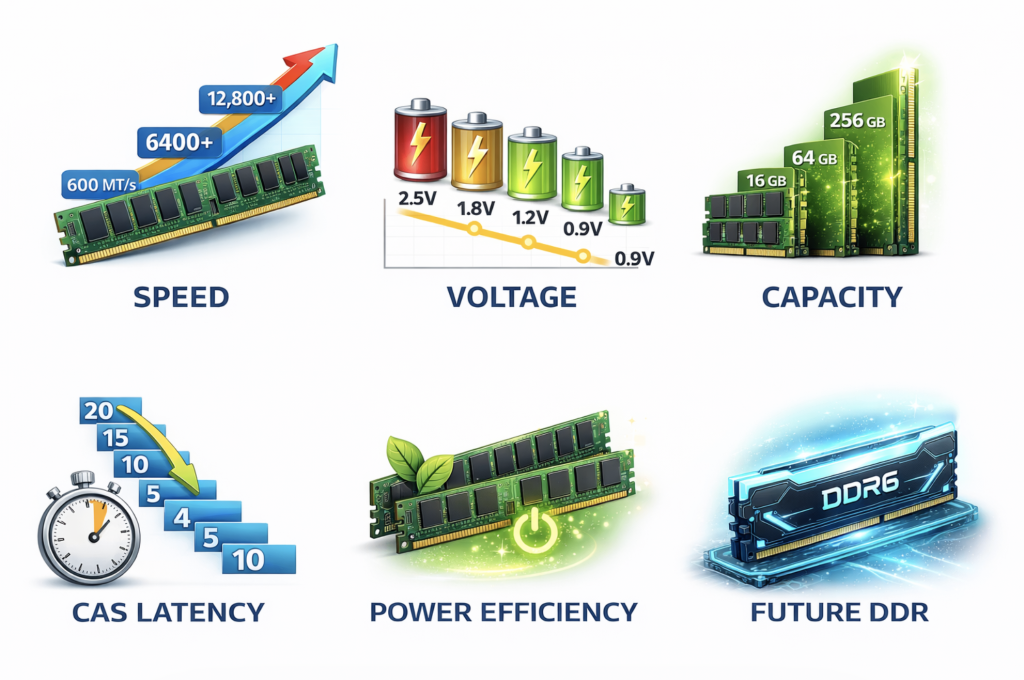
DDR Memory Compatibility and Limitations
While newer DDR generations offer better performance and efficiency, compatibility still limits upgrades. In general, different DDR generations do not support each other. For instance, DDR3 cannot fit into a DDR2 slot, and DDR5 requires a completely different motherboard design.
Moreover, older generations such as DDR1 through DDR4 now offer limited value. They provide lower bandwidth and consume more power compared to modern DDR5 memory.
Today, manufacturers widely use DDR5 in new systems. However, many consumer PCs do not fully utilize its advanced features, such as on-die ECC and integrated power management (PMIC).
Looking ahead, the industry continues to develop DDR6. Although it promises extremely high performance, real-world adoption will depend on hardware support, cost, and market readiness. Initially, manufacturers will likely target AI systems, high-performance computing, and next-generation data centers.
DDR1 (First Generation DDR SDRAM)
DDR1 marked the transition from SDRAM by enabling data transfer on both clock edges. As a result, it significantly improved system responsiveness compared to earlier memory technologies.
With a data rate of 200–400 MT/s and a voltage of 2.5V, this generation laid the groundwork for modern high-speed memory. At the time, manufacturers widely deployed it in early desktops, laptops, and entry-level servers.
However, its limited bandwidth and relatively high power consumption make it obsolete today.
DDR2 (Second Generation)
Building on the first generation, DDR2 introduced higher clock speeds along with improved power efficiency. In particular, it reduced the voltage to 1.8V, which helped lower energy consumption.
Additionally, DDR2 adopted a 4n prefetch architecture, allowing it to achieve data rates between 400 and 1066 MT/s. This made it suitable for mainstream desktops and laptops, especially for multitasking and multimedia applications.
Furthermore, engineers improved signal integrity and system stability through features such as on-die termination.
DDR3 (Third Generation)
Compared to DDR2, DDR3 delivered a substantial increase in performance while further reducing power consumption. For example, it operates at 1.5V, with a low-voltage variant (DDR3L) at 1.35V.
At the same time, the introduction of an 8n prefetch architecture enabled data rates ranging from 800 to 2133 MT/s. Consequently, many manufacturers adopted DDR3 for gaming PCs, workstations, and servers.
Thanks to its balance between cost, performance, and efficiency, DDR3 achieved widespread popularity across multiple platforms.
DDR4 (Fourth Generation)
DDR4 brought major architectural improvements, particularly in terms of memory density and scalability. For instance, it introduced bank group architecture, which enhanced parallel data processing.
Operating at a lower voltage of 1.2V, DDR4 also improved energy efficiency while supporting data rates from 1600 to 3200 MT/s. As a result, system builders selected it as the standard for desktops, servers, and data centers.
In addition, DDR4 offers better reliability and supports larger memory capacities, making it ideal for virtualization, cloud computing, and high-performance workloads.
DDR5 (Fifth Generation)
DDR5 represents a significant leap forward in memory technology. Not only does it provide much higher bandwidth, but it also introduces several architectural innovations.
For example, DDR5 features dual independent 32-bit sub-channels, which improve data efficiency. In addition, it integrates on-die ECC for error correction and includes a built-in power management IC (PMIC).
With data rates starting from 4800 MT/s and exceeding 8400 MT/s, DDR5 supports demanding applications such as AI, cloud computing, and advanced gaming systems.
Overall, this generation addresses the growing need for faster, more reliable, and energy-efficient memory solutions.
DDR6 (Next-Generation Memory – In Development)
Looking toward the future, DDR6 will push memory performance even further. Although engineers have not finalized all specifications, early estimates suggest data rates between 8800 and 12800+ MT/s.
In addition, developers are designing DDR6 with improved channel architectures and higher bandwidth efficiency. These enhancements will support cutting-edge applications, including AI training, real-time simulations, and large-scale data processing.
While its full impact remains to be seen, DDR6 will likely play a crucial role in next-generation computing platforms.
Key Differences Summary
Generation | Data Rate (MT/s) | Voltage | Prefetch | Key Improvement |
DDR1 | 200–400 | 2.5V | 2n | Basic DDR architecture |
DDR2 | 400–1066 | 1.8V | 4n | Higher speed, lower power |
DDR3 | 800–2133 | 1.5V | 8n | Efficiency and stability |
DDR4 | 1600–3200 | 1.2V | 8n | Higher density, bank groups |
DDR5 | 4800–8400+ | 1.1V | 16n | Dual channels, PMIC, ECC |
DDR6 | 8800–12800+* | TBD | 16n+ | Next-gen bandwidth |
*Expected values
The Future of DDR Technology
As computing continues to evolve, memory technology will remain a critical factor in system performance. In particular, DDR6 will support AI, cloud computing, and high-performance computing (HPC) workloads.
Moreover, it may work alongside emerging technologies such as LPDDR6 and HBM, enabling even greater efficiency and scalability. Therefore, the future of DDR Memory points toward faster speeds, lower power consumption, and better support for data-intensive applications.